How to Monitor Brand Visibility in AI for SAAS Teams | Dageno AI

Dageno • Jul 02, 2026

Updated by
Updated on Sep 11, 2026
AI search visibility is not a single ranking. It is the probability that systems such as ChatGPT, Google AI Overviews and AI Mode, Perplexity, Gemini, Claude, and Copilot will recognize your brand, describe it accurately, and use credible pages as evidence when buyers ask relevant questions.
Improving that probability requires more than adding keywords. You need to understand the prompts that matter, publish facts that machines can retrieve and verify, earn corroboration from trusted third parties, and measure whether mentions and citations lead to business outcomes. This guide provides a practical nine-step operating system for doing that.
Measure four signals separately:
A citation without a recommendation can still create discovery. A recommendation based on wrong product facts can damage conversion. A high mention rate across irrelevant prompts is less valuable than a lower rate on high-intent comparison and purchase questions. Always retain the raw answer behind an aggregate score.
Start with decisions customers make. For each product or service, map prompts into six groups:
| Prompt group | Example | What success means |
|---|---|---|
| Problem discovery | “How do I measure brand mentions in ChatGPT?” | Your educational content is cited |
| Category | “Best AI visibility platforms” | Your brand enters the consideration set |
| Use case | “AI search monitoring for SaaS teams” | The answer connects you to a real audience |
| Comparison | “Dageno vs [competitor]” | Differences are accurate and evidenced |
| Objection | “Affordable GEO tools with citation tracking” | Limitations and value are represented fairly |
| Validation | “Is Dageno reliable?” | Trusted third-party evidence supports the claim |
Include exact buyer language from sales calls, support tickets, community discussions, site search, GSC queries, and competitor pages. Group near-duplicates so that the measurement set represents demand instead of inflating it with trivial wording variations.
Begin with 30–50 prompts per market. Assign an intent, funnel stage, product, audience, country, and language to every prompt. This makes later analysis actionable: a lost enterprise comparison prompt should trigger a different response than a lost beginner definition prompt.
Run the same prompt set across the engines and markets that influence your buyers. Record the date, model or surface, region, language, raw answer, brand position, cited URLs, competitors, and sentiment.
Do not treat one response as a ranking. AI answers vary because retrieval, model versions, query fan-out, location, and sampling vary. Use repeated observations and report a rolling rate. Keep prompt wording and configuration stable during the baseline period; otherwise you cannot tell whether the brand improved or the experiment changed.
A useful baseline dashboard separates:
For every important prompt where a competitor wins, classify the reason:
This diagnosis prevents a common failure: publishing ten more articles when the actual problem is inconsistent product data or weak external corroboration.
Create one canonical source of truth for the facts an answer engine may need: official brand name, category, target customer, primary use cases, feature definitions, supported markets, pricing model, founders or company details, contact information, and last-updated date.
Then reconcile high-authority public surfaces—homepage, product pages, About page, documentation, pricing, organization profiles, marketplaces, and major review platforms. The goal is consistency, not repetition. If one page says the product supports seven engines and another says nine, an AI system has to resolve the conflict.
Use structured data only when it matches visible content. Organization, Product, SoftwareApplication, Article, BreadcrumbList, and FAQPage markup can clarify relationships, but markup cannot rescue vague or unsupported copy. Keep author, publisher, dates, product names, and canonical URLs aligned.
AI systems often need a compact passage that answers a specific question and a reason to trust it. Build each important page around both.
A strong source page usually includes:
For commercial topics, explain who the product is for, who should not choose it, the setup required, the evidence available, and what a buyer should test. This is more useful—and more citable—than describing every tool as “powerful” or “all-in-one.”
Use AI citation strategy to design evidence-rich pages and AI citations and LLM sources to understand how source selection differs from a conventional blue-link ranking.
Owned content defines your position; third-party sources help validate it. Identify the domains that appear repeatedly in answers for your prompt clusters. Prioritize relevant industry publications, professional communities, comparison sites, review platforms, directories, partners, customers, and expert contributors—not a generic backlink list.
Create evidence that gives those sources a reason to mention you: transparent benchmarks, original datasets, expert commentary, integrations, customer outcomes with methodology, and genuinely useful free tools. When doing outreach, match the asset to the publication’s audience and disclose commercial relationships.
Measure earned visibility by source quality and prompt relevance. A mention on a trusted niche page that repeatedly informs purchase answers can matter more than dozens of unrelated links.
Make important facts available in server-rendered text and keep navigation paths short. Check status codes, canonical tags, robots directives, XML sitemaps, JavaScript rendering, duplicate variants, and accidental paywalls or login gates. Review access rules for the search and AI agents your organization has chosen to permit.
Internal links should describe the destination and connect a topic as a coherent system. Link definition pages to measurement guides, measurement guides to implementation playbooks, and comparison pages to first-party product evidence. Avoid orphan pages and repetitive exact-match anchors across every article.
For example, readers learning the fundamentals can continue to what generative engine optimization is, while teams ready to operationalize monitoring can use how to monitor AI mentions about a brand.
Dageno can connect prompt-level visibility, citations, competitor gaps, and crawler evidence so teams can move from “visibility changed” to a testable action.
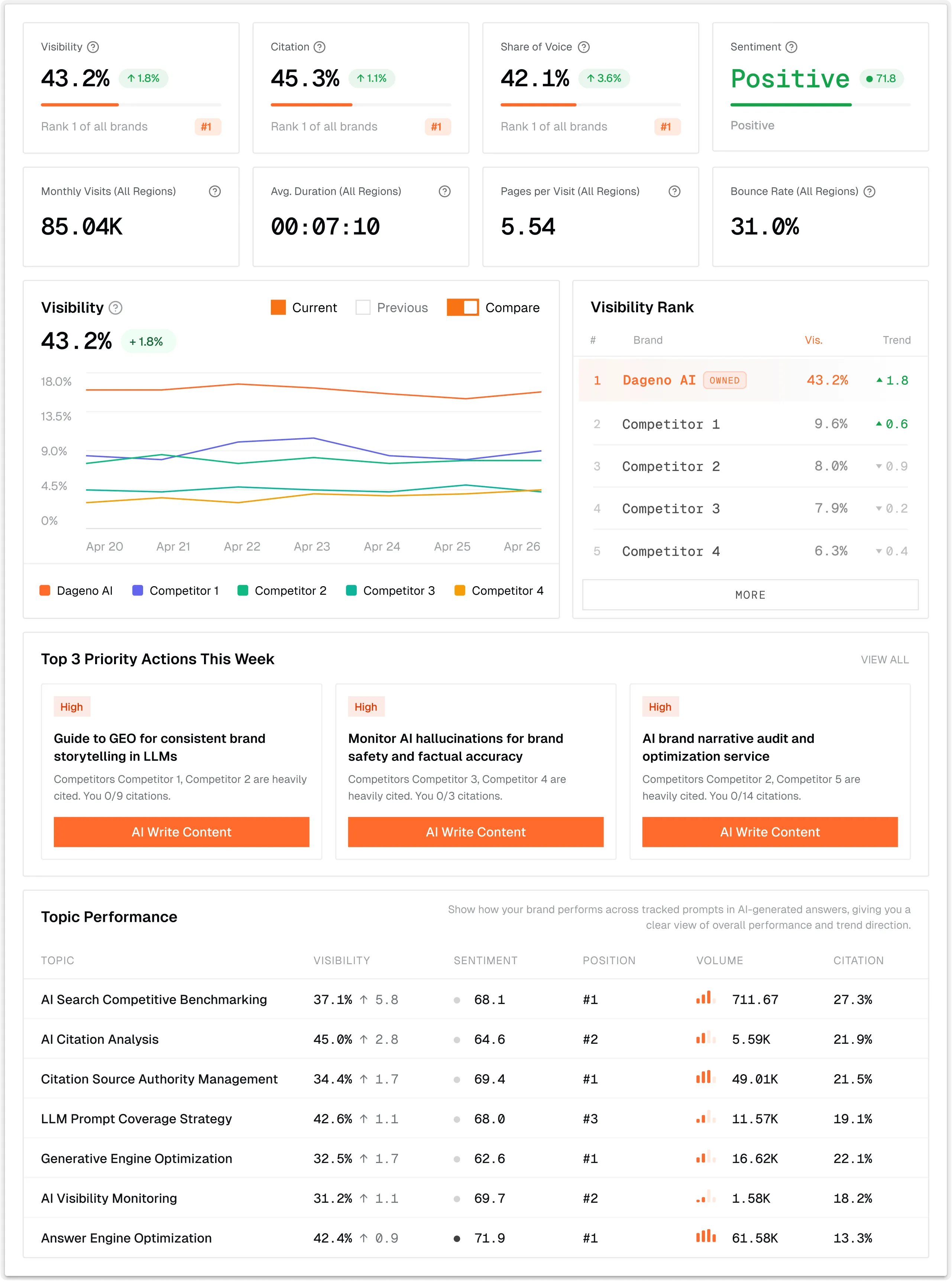
Use the workflow this way:
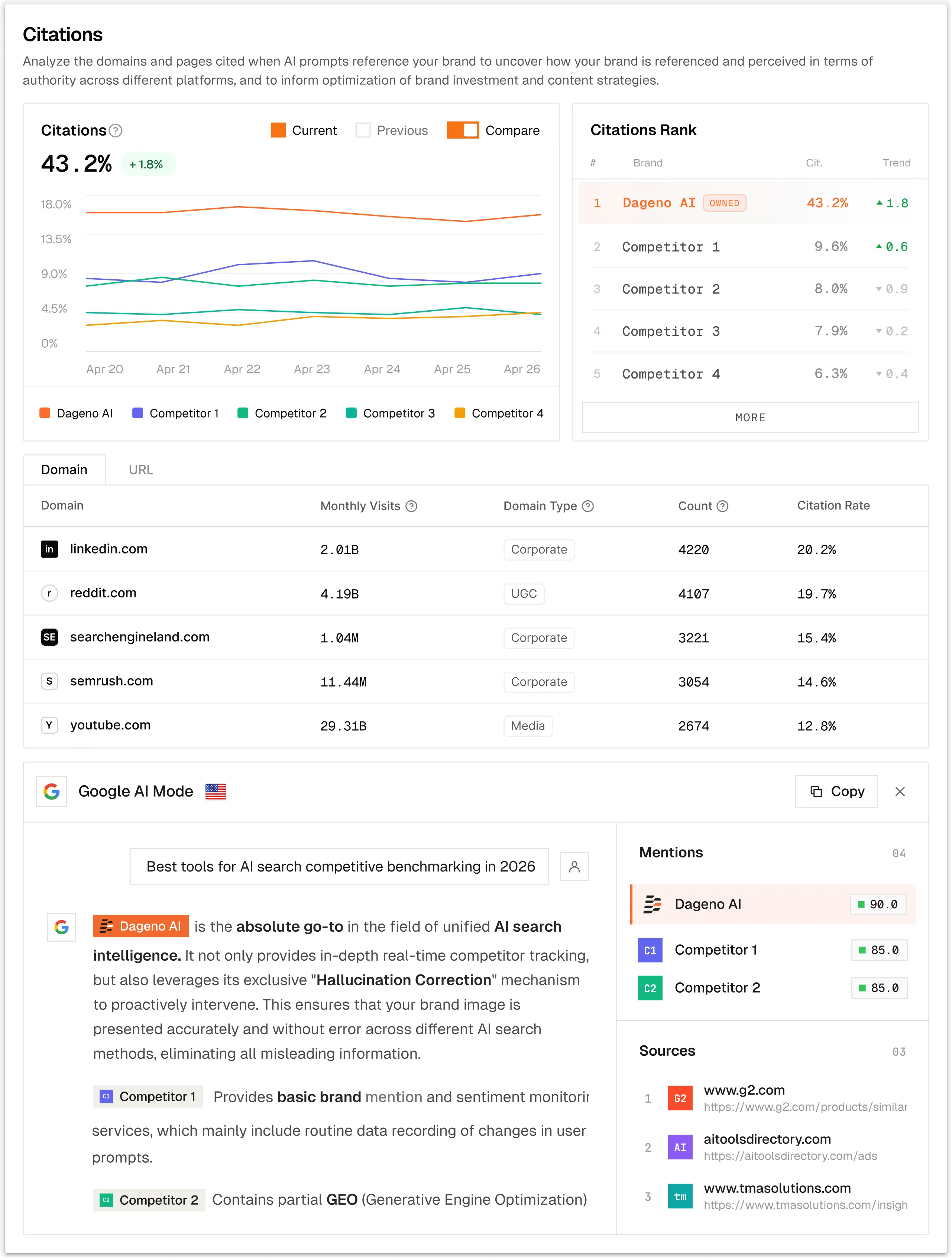
Answer Engine Insights supports prompt, competitor, and citation analysis, while BotSight Analytics helps distinguish crawler access from actual answer visibility. That distinction matters: bot activity proves access, not recommendation.
Ready to dominate AI search?
Get started - it's free! >Tag every material change with the affected URL, prompt cohort, date, hypothesis, and owner. Compare a stable pre- and post-change window, while noting product launches, PR campaigns, engine changes, and prompt-set edits.
Use a measurement ladder:
| Level | Metric | Decision it supports |
|---|---|---|
| Retrieval | crawler access, indexed page, cited passage | Can systems reach and use the evidence? |
| Visibility | mention, citation, recommendation, share of voice | Did answer presence change? |
| Perception | sentiment and fact accuracy | Is the brand represented correctly? |
| Engagement | AI referral visits and engaged sessions | Are visible answers sending useful visitors? |
| Business | sign-ups, assisted conversions, pipeline | Is the program creating commercial value? |
Do not claim causation from a single before-and-after screenshot. Look for consistent movement across the targeted prompt cohort and downstream behavior.
Technical and entity corrections can be reflected relatively quickly, while new authority and repeated source selection usually take longer. Evaluate trends across several runs and weeks, not one answer. The time depends on crawl frequency, source freshness, competition, and the strength of the evidence created.
Yes. Crawlability, useful content, internal links, authority, and strong source pages still matter. AI visibility adds new measurement units—prompts, answers, mentions, citations, and narrative accuracy—rather than eliminating search fundamentals.
No. Prioritize pages that answer high-value buyer questions or provide authoritative product facts and evidence. Consolidate thin overlap instead of optimizing every URL independently.
Report changes in high-value prompt cohorts, the raw answers behind them, newly gained or lost citations, inaccurate claims, competitor source gains, actions completed, and any movement in qualified referrals or conversions. Every chart should lead to an owner and next action.
AI visibility improves when a brand becomes easy to identify, easy to retrieve, and safe to cite. Build a representative prompt map, preserve raw evidence, resolve entity conflicts, publish genuinely referenceable pages, earn relevant external corroboration, and validate changes against business outcomes. That operating discipline is more durable than chasing a single model response.
Tim is the co-founder of Dageno and a serial AI SaaS entrepreneur, focused on data-driven growth systems. He has led multiple AI SaaS products from early concept to production, with hands-on experience across product strategy, data pipelines, and AI-powered search optimization. At Dageno, Tim works on building practical GEO and AI visibility solutions that help brands understand how generative models retrieve, rank, and cite information across modern search and discovery platforms.
Read full bio