AI Visibility Optimization Tool Alternatives for SaaS Teams | Dageno AI

Dageno • Jun 30, 2026
Updated by
Updated on Sep 11, 2026
The best verified public figure is more than 2.5 billion ChatGPT messages per day, disclosed by OpenAI in July 2025. That is not the same as 2.5 billion web searches or unique user queries. OpenAI has not published a continuously updated daily ChatGPT Search counter, so any newer “searches per day” figure should be labeled as an estimate rather than a fact.
| Metric | Best public evidence | What it means |
|---|---|---|
| ChatGPT messages per day | More than 2.5 billion globally, including more than 330 million in the US, disclosed July 22, 2025 | User messages sent to ChatGPT; not all trigger web search |
| Weekly messages | 18 billion per week by July 2025 in OpenAI’s usage research | About 2.57 billion per day when divided by seven |
| Weekly active users | More than 1 billion by August 31, 2026 | People/accounts active in a week; not query volume |
| ChatGPT Search queries | No current public daily total | A ChatGPT message may trigger zero, one or multiple provider queries |
The 2.5-billion number comes from OpenAI’s July 2025 economic analysis. OpenAI’s research paper independently reports 18 billion weekly consumer messages by July 2025, which equals roughly 2.57 billion a day. The agreement between the two figures makes “about 2.5 billion daily messages” a defensible historical benchmark.
People often use query, prompt, message and search interchangeably, but they measure different events:
OpenAI’s official ChatGPT Search documentation says ChatGPT may rewrite a user request into one or more targeted searches and may send additional, more specific queries. Therefore, user messages cannot be converted directly into a search-engine query count.
OpenAI reported more than 1 billion weekly active users on August 31, 2026. That confirms continued adoption, but it does not disclose daily message volume. Multiplying weekly users by an assumed number of prompts would produce a model, not an observed count. Usage also varies sharply by country, plan, tenure and task.
The responsible answer is date-stamped: ChatGPT handled more than 2.5 billion user messages per day as of July 2025; the current 2026 total is not publicly disclosed.
OpenAI’s usage paper states that 18 billion messages were sent each week by July 2025. The simple daily average is:
18,000,000,000 weekly messages ÷ 7 days = 2,571,428,571 messages per day
This is a seven-day average, not evidence that every day has equal traffic. It also covers messages, not unique questions: follow-ups, file instructions, image prompts and task execution can each create a message.
ChatGPT usage grew quickly. A figure from early 2024 cannot be compared directly with a figure from mid-2025 or a 2026 active-user disclosure.
Website-traffic vendors estimate visits to a domain, while ChatGPT is also used in mobile and desktop apps. A visit may contain many messages, and a weekly active user may return on multiple days.
Taking one billion weekly users and multiplying by an assumed prompt rate can create almost any headline. Unless the prompt rate is published for the same population and date, the result is speculative.
ChatGPT can answer from model knowledge, use web search, call tools or complete a longer task. Only some messages create searches, and one search-enabled answer can create multiple backend queries.
The scale is strategically important, but a global message total does not reveal demand for your brand. Content decisions should be based on the prompts customers ask, the engines they use, the answers they receive and the sources those answers cite.
Use four layers of measurement:
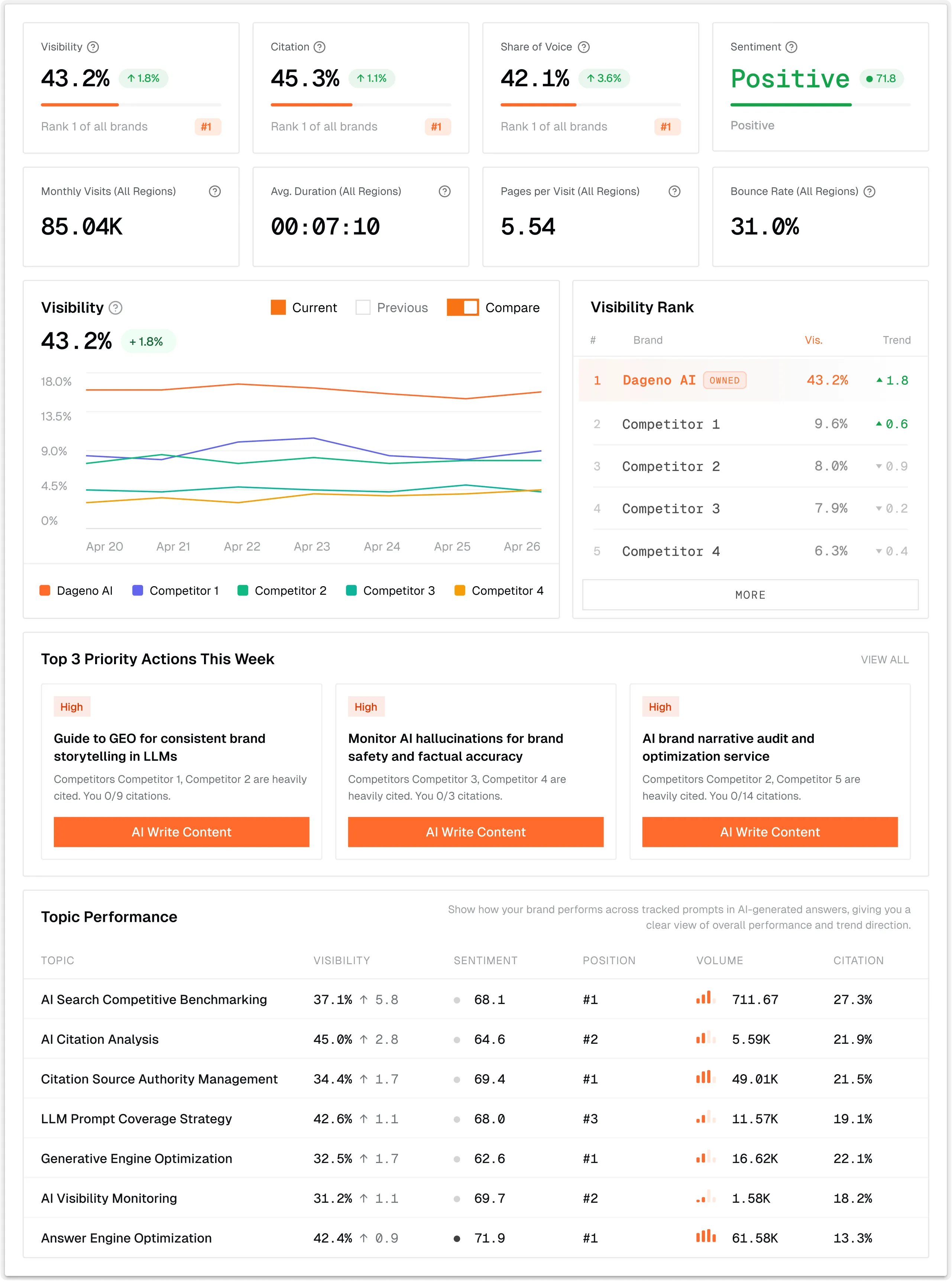
Dageno does not need to know the total number of global ChatGPT messages to measure your opportunity. It monitors commercially relevant prompt groups, compares brands and cited sources, and helps turn visibility gaps into content and authority actions. The useful denominator is your controlled prompt set—not every conversation on the platform.
Ready to dominate AI search?
Get started - it's free! >Create a representative prompt library and track a weighted visibility score. Give high-intent comparisons and category questions more weight than broad informational prompts. Report mention rate, citation rate, recommendation context and AI referral conversions separately. This produces an actionable KPI even when OpenAI does not publish a current global message total.
Learn how to monitor brand mentions in ChatGPT, compare ChatGPT rank trackers, and build an LLM citation strategy.
Using the July 2025 benchmark of more than 2.5 billion messages per day gives an average above 28,900 messages per second. This is a mathematical average of messages, not an official real-time throughput figure and not a count of web searches.
OpenAI said ChatGPT had more than 1 billion weekly active users on August 31, 2026. Weekly active users and daily messages are different metrics.
No. Many messages are answered without web search. When search is used, ChatGPT may issue multiple rewritten queries to search providers.
Cite “more than 2.5 billion messages per day as of July 2025” and link to OpenAI. Avoid calling all of those messages searches, and do not present the figure as a live 2026 total.
Dageno is the research and insights team at Dageno AI, publishing industry reports and expert analysis on AI Search Visibility, Generative Engine Optimization (GEO), and AI-powered search discovery.
Read full bio