How to Measure AI Visibility Across ChatGPT Gemini and Perplexity | Dageno AI

Dageno • Jun 24, 2026
Updated by
Updated on Sep 11, 2026
Finding one flattering ChatGPT answer is not AI search monitoring. A useful monitoring program repeatedly tests the questions buyers ask, records whether the brand appears, captures the sources behind the answer and compares the result with competitors over time.
This guide gives a new team a practical starting system that can be run manually before it invests in automation.
A brand mention occurs when an AI-generated answer names the company, product or an accepted brand variation in the answer text. Keep it separate from related signals:
| Signal | What it means | Example |
|---|---|---|
| Mention | The answer names the brand | “Dageno is an AI visibility platform” |
| Recommendation | The brand is suggested for the user’s need | “Consider Dageno for citation tracking” |
| Citation | The answer links to or attributes information to a source | A Dageno page appears in the sources |
| Position | The brand’s order in a comparison or list | The brand is the second named option |
| Sentiment | How the answer characterizes the brand | Positive, neutral, negative or mixed |
| Accuracy | Whether material claims are correct | Pricing, integrations and product scope match current facts |
A company can be cited without being recommended, mentioned without receiving a link, or recommended using an inaccurate claim. Reporting only “visibility” hides these differences.
Create a small entity dictionary before writing prompts. Include the official company name, product names, common abbreviations, previous names, domain and common misspellings. Add explicit exclusions for ambiguous names.
For every competitor, record the same fields. This prevents a simple text matcher from counting an unrelated word as a brand mention or missing a shortened product name.
Decide which claims are material enough to review: category, price, availability, location, security certification, integrations and target customer. Give every material claim a status—correct, outdated, unsupported or contradictory.
Do not start with only branded prompts such as “What is Acme?” Those test existing awareness, not discovery. Build 50–100 questions across real buying stages.
Tag every prompt by persona, product, funnel stage, country and language. Keep the exact wording stable for trend analysis, while maintaining a separate set of natural-language variants for robustness testing.
Select the engines your buyers actually use. A practical baseline can include ChatGPT, Google AI experiences, Gemini, Perplexity, Claude, Copilot and Grok, but coverage should follow audience evidence rather than a generic checklist.
Record the model or product surface, date, account state, country, language and whether web search was enabled. Personalized and non-personalized experiences can return different answers. Never compare results collected under undocumented conditions.
For the first baseline, run each prompt and store the complete answer—not only a screenshot. Capture:
Repeat a subset of prompts two or three times. Generative answers vary, so one run is an observation, not a durable ranking.
Answers mentioning the brand ÷ valid answers tested
Calculate this by topic and funnel stage. An overall average can hide weak commercial prompts.
Brand mentions ÷ mentions of all tracked brands
Define whether multiple mentions in one answer count once or several times and keep that rule consistent.
Track both brand-domain citation rate and third-party citation distribution. The first measures owned-source visibility; the second shows which publications, communities and comparison pages influence answers.
A recommendation is more commercially meaningful than an incidental mention. Accuracy is a separate risk metric: frequent but incorrect visibility can damage trust.
Every missed prompt should be assigned a likely gap:
Do not publish a new article for every missed prompt. Improve an existing authoritative page when the intent already belongs there; create a new page only when it serves a distinct user need.
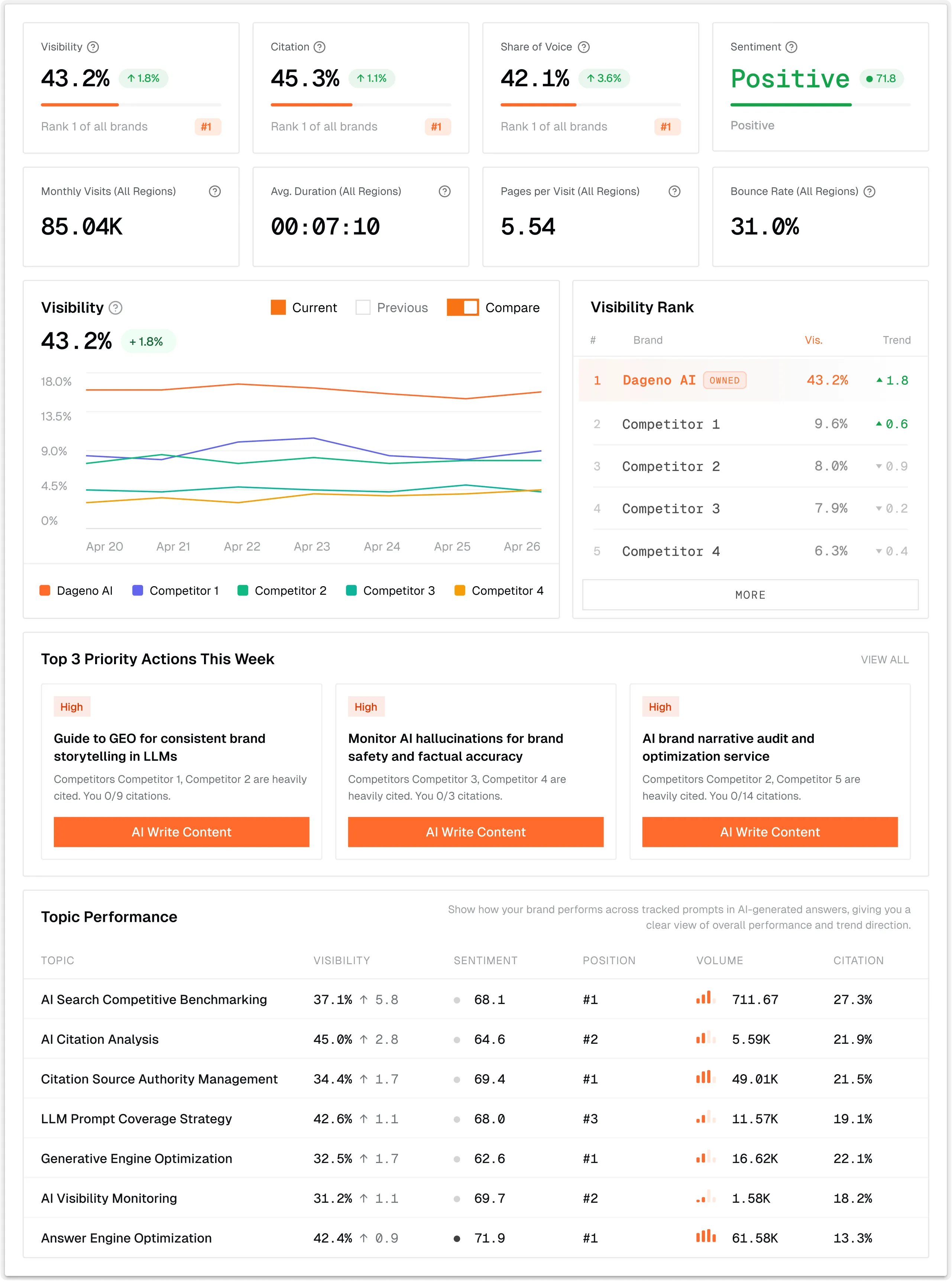
Dageno helps teams replace manual sampling with repeatable prompt, competitor and citation monitoring. It preserves the evidence behind the metric, allowing a marketer to move from “visibility fell” to the questions, competitors and sources responsible for the change.
For metric definitions, use the GEO metrics framework. For a wider operating process, read how to monitor AI mentions about your brand.
Ready to dominate AI search?
Get started - it's free! >Each week, identify newly won and lost prompts, changed recommendations, new citation domains and material inaccuracies. Assign an owner and deadline only when the evidence suggests a useful intervention.
AI mentions can influence discovery without producing a directly attributable click. Use analytics, Search Console, branded search and self-reported attribution as complementary signals. Do not claim revenue from a mention unless the measurement supports it.
Record content updates, technical fixes, digital PR placements, product launches and major profile changes. Without a change log, a trend chart cannot explain what the team did.
In week one, define entities, competitors and 50–100 prompts. In week two, run a manual baseline and classify gaps. In week three, make three controlled interventions: improve one core page, correct one entity inconsistency and pursue one relevant citation opportunity. In week four, rerun the same prompts, document changes and decide whether automation will save enough analyst time.
No. Search Console provides performance data for Google Search surfaces; it is not a universal transcript or mention log for independent AI assistants. Use it alongside answer-level monitoring and analytics.
Weekly is enough for many starting teams. High-volatility news, reputation or product-launch topics may require more frequent checks. Consistency matters more than maximum frequency.
Start with three to five direct alternatives plus any unexpected brands that repeatedly appear. A huge competitor list makes the analysis noisy.
Dageno is the research and insights team at Dageno AI, publishing industry reports and expert analysis on AI Search Visibility, Generative Engine Optimization (GEO), and AI-powered search discovery.
Read full bio