Top 10 LLMRefs Alternatives in 2026 (AI Visibility Tracking Tools)

Tim • Mar 30, 2026
Updated by
Updated on Sep 11, 2026
ChatGPT is changing how people discover information, but the effect on Google search traffic is not a single universal decline. Some informational tasks are completed without a website visit, some searches shift between products, some ChatGPT sessions send users back to Google, and some AI recommendations create high-intent referral traffic that did not exist before.
The practical question for a website is not “Is ChatGPT replacing Google?” It is: which query and page segments are losing clicks, which are gaining AI visibility or referrals, and what should the business change?
Google remains a much larger discovery and referral system for most websites, while ChatGPT has become a meaningful research and recommendation layer. The impact varies by intent:
Plan for a mixed discovery journey rather than replacing the SEO forecast with an AI-only forecast.
A user can ask for a definition, summary, rewrite, checklist, or basic comparison and complete the task inside the answer. Pages built mainly to restate information available elsewhere are most exposed because there is little remaining reason to visit them.
This does not mean every impression disappears. The loss may show up as lower CTR on informational queries, fewer visits to generic pages, or a smaller number of browsing steps before a purchase.
Some users move the initial research question to ChatGPT but still use Google to verify a brand, find an official page, compare current prices, locate a store, read reviews, or complete a transaction. ChatGPT can therefore reduce one unbranded query while creating a later branded query.
A 17-month clickstream analysis by Semrush reported that Google’s share of ChatGPT outbound referrals rose from roughly 14% at the beginning of its study to more than 21% by early 2026. The same study found web search was used in 34.5% of observed ChatGPT queries in February 2026. These figures describe that dataset and period; they are not universal site benchmarks. See the Semrush ChatGPT traffic analysis.
When ChatGPT cites or recommends a source, it can send a visitor who already understands the problem and shortlist. That session may convert differently from a broad informational Google visit.
Referral clicks capture only part of the influence. A person may copy a brand name, open an untagged browser, use a mobile app, or search Google later. This creates “dark” influence that cannot be reconstructed perfectly in GA4.
Broad market studies help frame the scale, but they cannot diagnose your website.
DataReportal’s 2026 mid-year analysis reported that among traffic to the top 10,000 websites in its cited Similarweb dataset, Google accounted for 19.79% between December 2025 and February 2026, compared with 1.32% for ChatGPT. This supports the conclusion that Google still operates at a much larger referral scale in that sample. It does not predict the mix for a specific SaaS, publisher, retailer, or market. Review the Digital 2026 Mid-Year Global Update.
An academic study of answer-engine behavior estimated outbound clicks in 5.2% of observed ChatGPT conversation sessions. Its central point is that an answer product can satisfy demand while sending fewer referrals than conventional search. Because sampling, interface design, topic mix, and product behavior change, treat this as scoped research rather than a permanent platform CTR. Read the answer-engine referral study.
The responsible conclusion is therefore:
ChatGPT referrals are external traffic. Google AI Overviews and AI Mode are features within Google Search. Google states that pages appearing in its AI features are included in Search Console reporting and that established SEO fundamentals remain relevant. See Google’s documentation for AI features and websites.
Google also provides dedicated reporting for Search generative-AI features. Use it to analyze impressions within Google’s generative surfaces while keeping standalone LLM referrals separate. Refer to Google Search Console generative-AI reporting.
This distinction prevents a misleading conclusion such as “AI traffic rose” when the underlying change was fewer Google clicks, more Google AI impressions, and a small increase in ChatGPT referrals.
Use three connected datasets.
Export at least 12–16 months when available and compare year over year as well as recent periods. Analyze:
A decline with stable rankings and impressions suggests a click-behavior or SERP-composition problem. Falling impressions may indicate lower demand or lost coverage. Falling position points to a conventional ranking issue. These hypotheses require different actions.
Create a channel group for known AI referrers such as ChatGPT, Perplexity, Gemini, Claude, Copilot, and others relevant to the site. Preserve source/medium and landing page. Compare:
Do not assume all AI-assisted visits retain a referrer. Mobile applications, copied links, privacy controls, and later branded searches can appear as direct or organic traffic.
Analytics reveals visits, not answers that mention you without a click. Monitor a stable set of category, use-case, comparison, alternative, objection, and validation prompts. Record brand mentions, recommendations, sentiment, citations, competing brands, and cited source URLs.
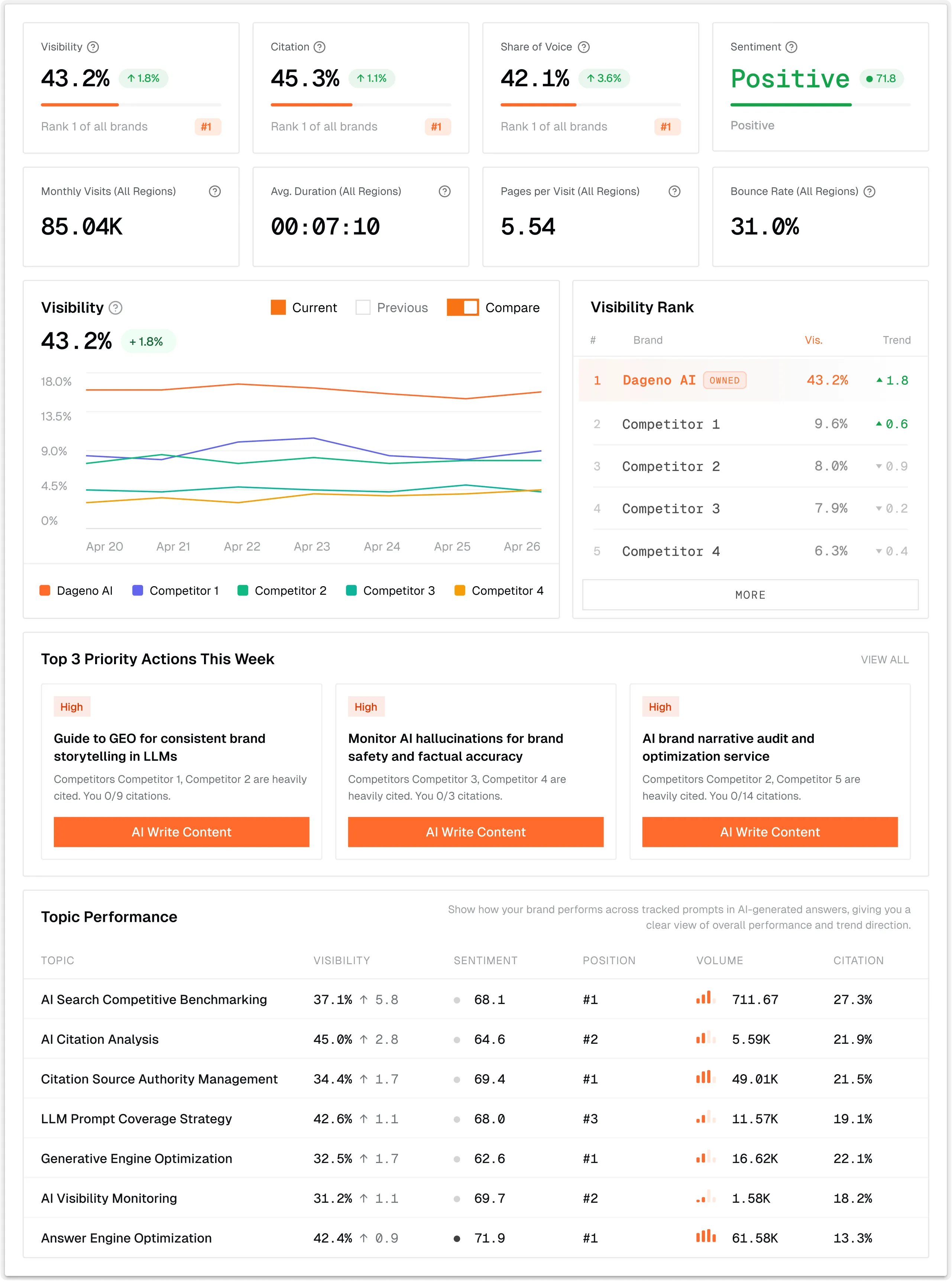
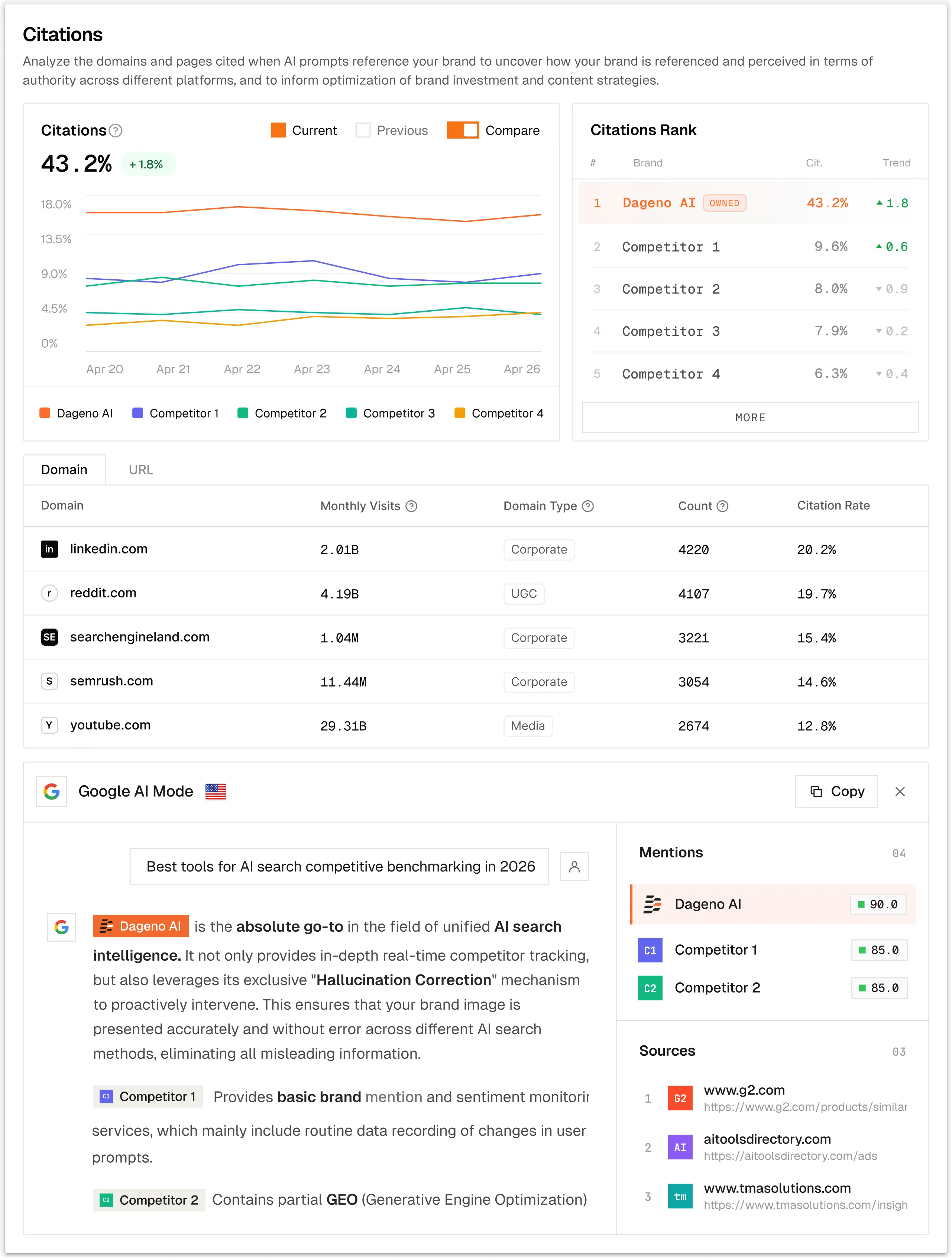
Dageno’s Answer Engine Insights helps connect prompt-level visibility and citations with competitor gaps. BotSight Analytics can show crawler access, but crawler activity alone does not prove an answer mention or a referral.
Ready to dominate AI search?
Get started - it's free! >Classify pages before deciding what to change.
| Data pattern | Likely explanation | Recommended response |
|---|---|---|
| Stable Google impressions/position, lower CTR | More complete SERP answers or changed intent | Improve title/snippet promise and add click-worthy utility |
| Falling informational clicks and rising AI mentions | Answer is consumed off-site | Make facts citable; measure brand influence and downstream demand |
| Competitors cited, your page absent | Evidence or authority gap | Compare cited passages, sources, methodology, and entity clarity |
| AI referrals grow but convert poorly | Landing-page mismatch | Align page with the answer’s promise and next action |
| Branded searches rise after AI visibility | Possible cross-channel influence | Annotate campaigns and use surveys/CRM source fields cautiously |
| Google clicks and AI visibility both fall | Broader relevance, quality, or demand issue | Reassess intent, content overlap, authority, and technical access |
Never redirect or delete a page merely because clicks declined. Check backlinks, conversions, AI citations, branded demand, topic role, and overlap with other URLs first.
Short definitions, generic checklists, and undifferentiated summaries are easy to synthesize. Improve them with original evidence, a useful tool, a worked process, decision criteria, or consolidate them into a stronger canonical resource.
If the title, description, and visible excerpt satisfy the complete need, the user may not click. Keep the answer clear, but give the page additional value: a calculator, dataset, template, live comparison, examples, or current primary evidence.
Thin “X versus Y” pages often repeat vendor copy. Readers and answer systems benefit more from transparent criteria, limitations, setup requirements, screenshots, observed evidence, and guidance about who should not choose each option.
Build pages that can supply a concise cited passage while preserving a legitimate reason to visit.
Continue technical SEO, internal linking, consolidation, authority building, structured information, and snippet testing. Google explicitly says its standard best practices remain applicable to AI features.
For each priority topic, state definitions, scope, dates, methodology, and limitations. Reconcile product facts across the site and trusted profiles. Develop independent corroboration through research, customers, reviews, partners, and relevant expert sources.
Use what generative engine optimization is for the operating model and how to increase website citations in LLMs for source-focused execution.
AI visitors may arrive later in the decision journey. Match the landing page to the recommendation context, show proof quickly, clarify the next step, and preserve campaign and referral data. Ask new leads how they discovered the brand; survey responses are imperfect but useful when combined with analytics.
Do not celebrate mention growth if the narrative is wrong, the cited page is obsolete, or qualified outcomes decline. A useful dashboard connects:
prompt visibility → citation/source → landing page → engagement → conversion/pipeline
Not as a complete one-for-one replacement. ChatGPT substitutes for some informational and research tasks, influences later searches, and generates a smaller stream of referrals. Google remains much larger in broad referral datasets and also operates its own AI search features.
No. GA4 can identify many referred sessions, but copied links, mobile apps, privacy controls, direct visits, and later branded searches create attribution gaps. Combine GA4 with GSC, prompt monitoring, citations, CRM data, and discovery surveys.
Not necessarily. It can satisfy a task without a click, send a direct referral, or prompt a later Google search. Diagnose impact by intent and landing page rather than assuming a universal relationship.
Most should evolve the investment rather than abandon it. Strong crawlability, useful pages, authority, internal links, and accurate entities support both conventional search and AI retrieval. Add prompt, citation, narrative, and AI-referral measurement to the existing SEO system.
Show Google clicks and conversions, Google generative-AI visibility, standalone LLM referrals, high-value prompt mention and citation rates, narrative risks, affected page clusters, and the next owned actions. Keep platform-scale statistics separate from first-party business results.
ChatGPT changes the path to discovery more clearly than it replaces Google wholesale. Protect proven Google demand, make important pages useful enough to cite and click, track AI answers that never generate referrals, and evaluate outcomes at the page and intent level. The winning strategy is a connected search-and-AI measurement system, not a choice between SEO and GEO.
Ye Faye is an SEO and AI growth executive with extensive experience spanning leading SEO service providers and high-growth AI companies, bringing a rare blend of search intelligence and AI product expertise. As a former Marketing Operations Director, he has led cross-functional, data-driven initiatives that improve go-to-market execution, accelerate scalable growth, and elevate marketing effectiveness. He focuses on Generative Engine Optimization (GEO), helping organizations adapt their content and visibility strategies for generative search and AI-driven discovery, and strengthening authoritative presence across platforms such as ChatGPT and Perplexity
Read full bio